Photographing the Milky Way (Part 1)

Last Saturday was a dark moonless night, making it an ideal night for astronomers and astro-photographers, to head out into the wilderness and stare at the night sky. For me this was my third outing of this kind, with the first attempt being over a year ago when I managed to capture the Polaris star trail. Since then I’ve been itching to give astro photography another try, only this time try and capture a near space object such as a star cluster or galaxy. Perhaps the easiest to photograph, primarily due to its sheer size and proximity to Earth, is our own galaxy – the Milky Way.

The picture below shows a portion of the Milky Way, which given the time of the year, its spiral arch can occupy a significant portion of the night sky. Below, is my friend Philippos – a buddy of mine who got me hooked into spending Saturday nights in the freezing cold out in the wilderness! He himself has invested a ton of money to purchase his telescope kit, which we are able to use to take pictures of deep space objects (by mounting the camera directly onto the telescope, effectively replacing the eye piece) and of near space objects (by piggybacking a second DSLR camera on top of the telescope). The telescope itself has an equatorial mount which when aligned correctly, it tracks the rotation of the earth, making both mounting methods quite effective since you are able to eliminate any star trails.

This picture however was taken with my camera mounted onto my tripod, and setting my exposure time to 20 secs. Any longer than that (given that I was using my 24-70 mm lens at the wide angle end) would have resulted in star trails – something that we wanted to avoid. To make Philippos stand out, I asked him to stand still, then used a red flashlight to effectively paint him into the picture.

Suffice to say that with warmer nights to come, I will be giving this technique several more tries. It is by no means an easy ordeal as there are a lot of technical variables to account for (more on that in a future post), so all I can do is read up and practice, practice, practice!

Astronomer - 1920c

Taken with my tripod mounted Canon 60D, and Canon 24-70 F2.8L lens at ISO 1600, F2.8, 20 second exposure.

Light Paintings turns a year old!

Wow – it’s already been a year! Never really thought this blog would make it this far. Chances were I was going to lose interest after the first couple of posts, but 44 posts/pictures later here we are. Looking back at this year I must say that keeping the blog up-to-date with new pictures has really helped me stay motivated, and dedicated in my hobby. As to whether I’ve improved as a photographer, only you can be the judge of that, all I know is that there is still a lot of work to be done.

On the occasion of this anniversary (which also marks the first half of 2013), I have decided to reflect on my New Year’s resolutions, and see how far I’ve gotten against the goals I’ve set at the beginning of this year.

  • Explore Cyprus (take 3 pictures depicting life in Cyprus): Technically not doing so well here. I’ve taken a couple of shots (Oak tree, Protaras Pier and the Windmill), which with the exception of perhaps the Windmill, the rest have been of places that were a bit too familiar to me. Still need to get out there and explore!
  • Long Exposures (2 pictures particularly in B&W): Done! Started off experimenting with my trip to Petra tou Romiou,  and then managed to get a decent pic of the Protaras Pier. I am really growing fond of this technique, so I will definitely keep experimenting.
  • New Types of Photography (try out 3 new types): Getting there. Managed to try out Studio portrait photography and I’ve taken a crack at deep space photography (not posted anything yet cause of my initial failed attempt), but some work still to be done here.
  • Frame a picture: Surprisingly done! My picture of the Lake Boat is now proudly hanging in my bedroom. Still need to place a floating frame around it to better fit the size of the wall, but its a done deal and here is the proof!

Overall not a bad first half of the year. Looking forward to the next 6 months, hopefully managing to exceed my goals!

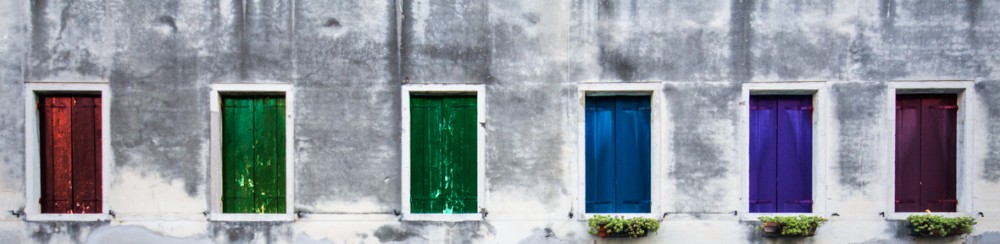
On this occassion, I’ve decided to post an old picture that I’ve taken about a year ago in the old part of Limassol, of an old house window.

Old Limassol Window - 1920c

Shot with my tripod-mounted Canon 60D and Sigma 18-200mm 3.5-6.3 OS lens, at ISO 100, F11, 1/15 sec and bracketed at -2/0/+2.

Heineken Splash

My inspiration for this weekend was to photograph beer splashing out of a bottle.  Spilling beer however is considered sacrilege by many men, so the precious liquid first had to be consumed and then replaced with water and a few drops of green food dye.

The setup was fairly simple – I first placed a white cardboard as my background, and positioned my speedlight aimed upwards so that the light would bounce off the cardboard and light up the scene. The bottle was then filled up with the green liquid, then poured downward into a collection vessel positioned below. While gravity was doing its job, I triggered my camera (set to continuous shooting mode) and managed to get 4-5 shots before the bottle was completely empty. I then refilled and tried again for a total of at least 5-6 rounds before I got the shot below. The picture was then inverted in Photoshop and voila!

Heineken Bottle2 - 1920c

Shot with my Canon 60D and Canon 24-70 F2.8L lens, at ISO 100, F8.0 at 1/200 sec. Flash was set to manual at 1/8th of its power.

A seven hundred year-old Oak tree

Situated in the village of Kalopanagiotis, only a 5-minute walk from the UNESCO heritage monasteri of Ayios Ioannis Lambadistis, is a small chapel by the name of Panagia Theoskepasti. The chapel got its Greek name “Theoskepasti” (which literally translates to “covered by God”) from an enormous Kermes Oak tree that has been planted in its yard, almost 700 years ago. Legend says that when the Turks invaded the Marathasa valley in 1571, many women and children found refuge in this chapel. When the soldiers tried to get into the chapel, the enormous tree saved everyone by lowering itself and covering this holy place with its dense foliage.

I have visited this chapel countless times ever since I can remember. Last Sunday however, I decided to take my camera with me in an attempt to capture the magnificence of this tree. With a height of almost 17 meters tall and a trunk nearly 4 meters in diameter, this picture definitely doesn’t do it justice. Perhaps I might make another attempt when I manage to buy myself a wider-angle lens!

Theoskepasti - 1920c

Taken with my Canon 60D and Sigma 3.5-6.3 18-200mm OS lens, at ISO 200, F.8.0 and bracketed at -3/0/+3.

Paint Splash Triptych

Walking into any contemporary art store, one is sure to find art pieces made up of either a single image cropped onto multiple canvases, or a series of images each mounted on a separate canvas. My personal favourite is the latter, as usually any one of the images can stand on its own, however when put together most often than not they tell a compelling story.

I can’t truthfully say that I had this in mind when I was experimenting with my paint splash project earlier in April. However once I started editing my images, I came up with the idea of creating a Triptych, depicting the fate of the paint drop as it hits the ground. Here are the 3 images in sequence – anyone think they would make for a good art piece on my wall?

triptych1a

Paint splash2 - 1920c

triptych3

Outdoor Portrait Photography

Of all the different types of photography I’ve tried, the one I find very challenging is portrait photography – especially when working outdoors where the elements of nature are always unpredictable. As they say however, practice makes perfect, so yesterday I went out for another round.

Admittedly though, this was not solely my idea.To my pleasant surprise it was Daria who came up with the initiative, at the same time volunteering herself as my model. Definitely an interesting turn of events, as she is usually simply an observer, occasionally nagging me about how long it takes me to take a single shot! Needless to say I didn’t hesitate a second, so just before sunset we left the house on a quest to find a decent photo location. Our short drive brought us to an abandoned hotel in the middle of Nicosia, which after closing due to financial problems a good decade ago, it has been left in a state of decomposition – a perfect location for a photo shoot!

I’ve been recently reading  about single light portraits and the dramatic effect they can produce. Since I only own a single speedlight, one can understand my interest in this technique! The picture below is one of the 2-3 decent pictures I managed to take during our 30-minute on-location shoot. For this shot, the flash gun was mounted off-camera on a tripod, elevated high up and aimed downwards towards Daria. Through the magic settings of camera and flash exposure, I managed to fully control both the ambient light and the light output of the flash gun. The resulting picture was then converted into B&W in Adobe Lightroom 4, with a few adjustments made to contrast and clarity.

Daria Outdoor Portrait - 1920cTaken with my Canon 60D, Canon 24-70mm F2.8L lens, at ISO 160, F8.0, 1/200 sec. Flash output was set to 1/2.

Paint Splash

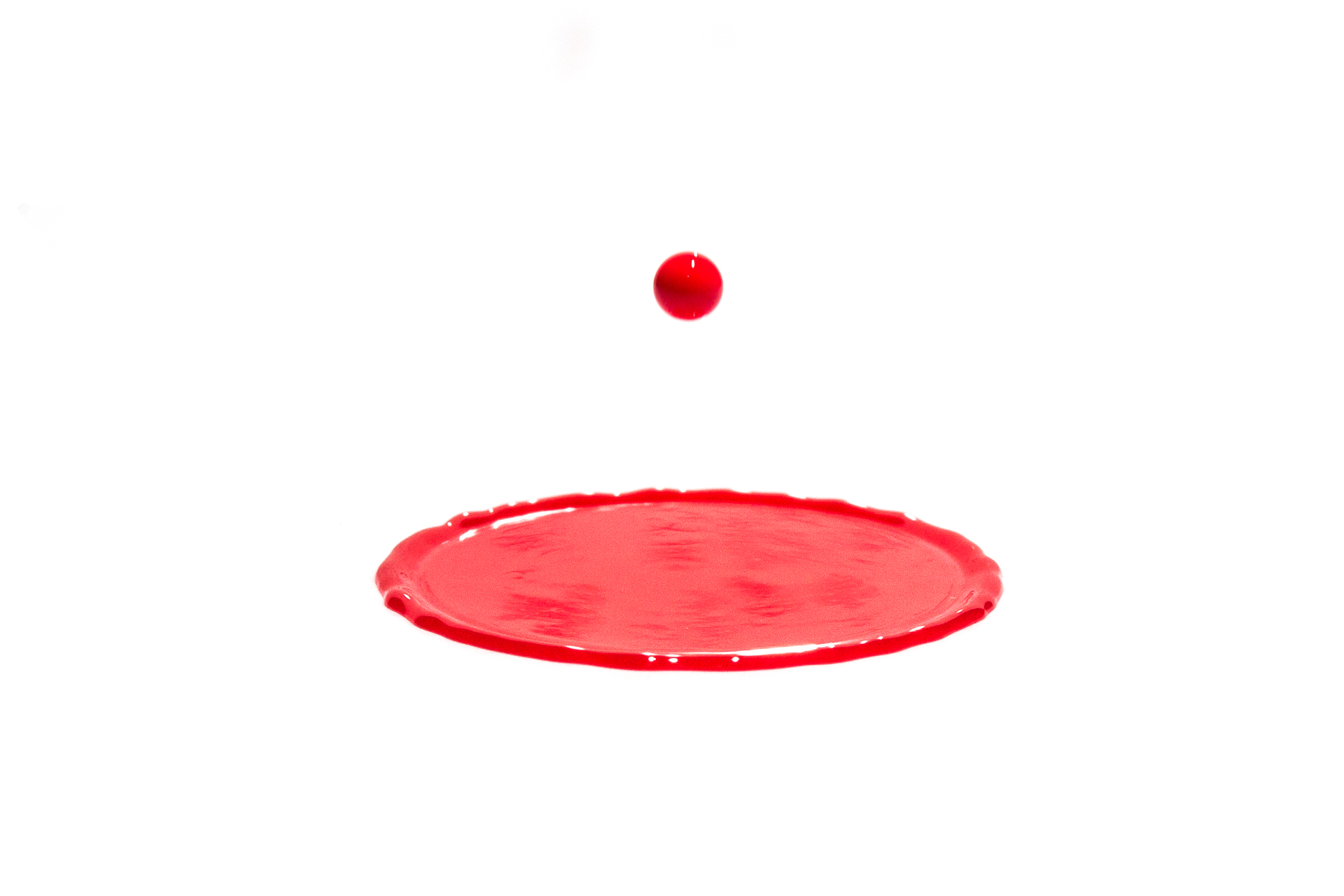
What better way to start the weekend than planning a photo shoot! This past Friday I left work and headed to do a bit of shopping in preparation for a mini project I’ve been wanting to do for some time now. The shopping list included a small bottle of red water-based paint, two glossy white ceramic tiles and an eye dropper. The idea was to photograph at high speed, a paint drop as it rebounds off the ground (or in this case one of the ceramic tiles).

The setup was fairly simple. I set the first tile flat on a coffee table, then placed the second tile perpendicular to it, essentially creating a mini studio. I then watered down my paint, squeezed some into my eyedropper, and then fixed the eyedropper vertically above the flat tile onto one of my tripods. I then fixed my speedlight flash near the eyedropper facing down, so that the light would rebound off the standing tile. Here is a photo taken with my cell phone of the entire setup (link).

With a towel standing by, I then started squeezing drop after drop, while triggering my camera with my wireless remote. It took a bit of luck and coordination, but boy was I happy when I managed to get this beautiful red crown!

Taken with my Canon 60D and Canon 100mm F2.8 macro lens, at ISO 200, F16, 1/200th of a sec. Flash set to manual at 1/16th of its power output.

Paint splash2 - 1920c

Protaras Pier

March was a relatively short month work-wise, as we were lucky to have 3 back to back national holidays fall on Mondays. Unfortunately however, the first 2 of those long weekends were spent by most people (including myself) at home, glued to our TV-sets, following minute by minute updates of the events that have taken our economy back a good 40 or so years. Unable to see a minute more of yet another incompetent politician being interviewed on TV, I decided to get out of town this past weekend and seek an outlet from this really depressing environment.

On Sunday afternoon, I found myself gear in hand walking down the Sunrise beach boardwalk in Protaras. To my excitement I saw this pier extending into the sea, and without a second thought I started setting up my tripod to take the shot. The outcome is the following image, the result of a 4 minute and 10 second exposure! Luckily, the people on the pier were not standing still so they were not recorded as part of the image. On the downside, the heavy dust in the atmosphere at sunset completely masked any movement of the clouds.

Shot with my tripod mounted Canon 60D, Canon 24-70 F2.8L lens, at ISO 100, F16, 250 secs. For this shot I mounted both my circular polariser and ND 3.0 lens to effectively get a 12-stop reduction in my shutter speed.

Protaras Pier - 1920c

Windmill

A couple of weekends ago on a Sunday afternoon, I decided to drive to the village of Koshi near Larnaca. The area surrounding this village is now the home of a couple of wind farms, making the location ideal for some windmill landscape shots. I rarely go out on my own to shoot pictures, but I must admit I found this experience greatly relaxing as I took the time to drive around and get acquainted with the area looking for the ideal composition.

The result of this short expedition, is the photograph below. For this picture I busted out my circular polarising filter. For anyone unfamiliar with this piece of equipment, this filter enhances the colours of the image, giving a bit more contrast while at the same reducing glare/reflections. It works best when the scene is side-lit such as in this case.

Shot with my tripod mounted Canon 60D and Canon 24-70 F2.8L lens at ISO 100, F11 and 1/100 exposure. Come to think of it, given that I was using a tripod and this was a landscape picture, I could have pushed my aperture down to F16 to increase sharpness. Not sure what happened there!

Windmill

Strawberry Plunge

I had this itch over the last 3-4 days to try a new technique. One of my favourite professional photographers, to whom I owe most of my knowledge in photography, is Mark Wallace. In one of his recent Exploring Photography video tutorials, he demonstrated the technique of high-speed photography by using a very simple setup – a tripod-mounted camera and an off-camera flash. So I decided to give it a try and photograph a strawberry plunging in milk.

The technique itself was fairly trivial. Simply set the camera to manual mode with a long exposure (over a second) and a small aperture to get a decent depth of field. Turn all the lights off, trigger the camera, drop the strawberry and just as it hits the surface of the milk, trigger the flash. Needless to say it requires a lot of coordination and patience before you get a decent shot, especially when you are trying to do this all by yourself without someone helping you or any wireless triggers!

Shot with my Canon 60D and Canon 100mm F2.8 macro lens at ISO 100, F16 and a 4 second exposure. Flash was set to manual at 1/16th power.

Strawberry in Milk - 1920c